A Simple Step-by-Step Guide on How to Operate an Oven in the UK (For Complete Beginners)
Using an oven for the first time can feel scary. Many people in the UK, especially students, renters, and people living alone, feel confused when they see different knobs, symbols, and numbers. Some ovens have fan symbols, some have grill lines, some use Celsius, and some even have both grill and oven in the same space.
I remember the first time I moved to the UK and tried to use the oven in my rented flat. The oven had so many symbols that looked like secret signs. I turned one knob, nothing happened. I turned another, and the light came on. I kept turning until I smelled hot air. That day, I burnt my garlic bread because I had no idea the fan oven cooked faster.
So if you are also confused, trust me, you are not alone.
This guide is written in the simplest way possible so anyone—especially beginners—can understand how to operate a UK oven safely and correctly.
Let us start slowly and clearly.
What You Should Know Before Starting
Ovens in the UK are usually of two types:
-
Electric oven
-
Gas oven
Some homes also have combination ovens with grills or fan settings.
Most UK ovens use Celsius for temperature, not Fahrenheit. That alone can confuse people who come from countries that use Fahrenheit.
But do not worry. You will understand everything in a few minutes.
Why This Guide Helps Beginners
-
Simple, short sentences
-
Clear steps
-
Real user experience
-
No complex cooking terms
-
No confusing instructions
-
Answers to the most searched beginner questions
-
Works for rented flats, student accommodation, and shared kitchens
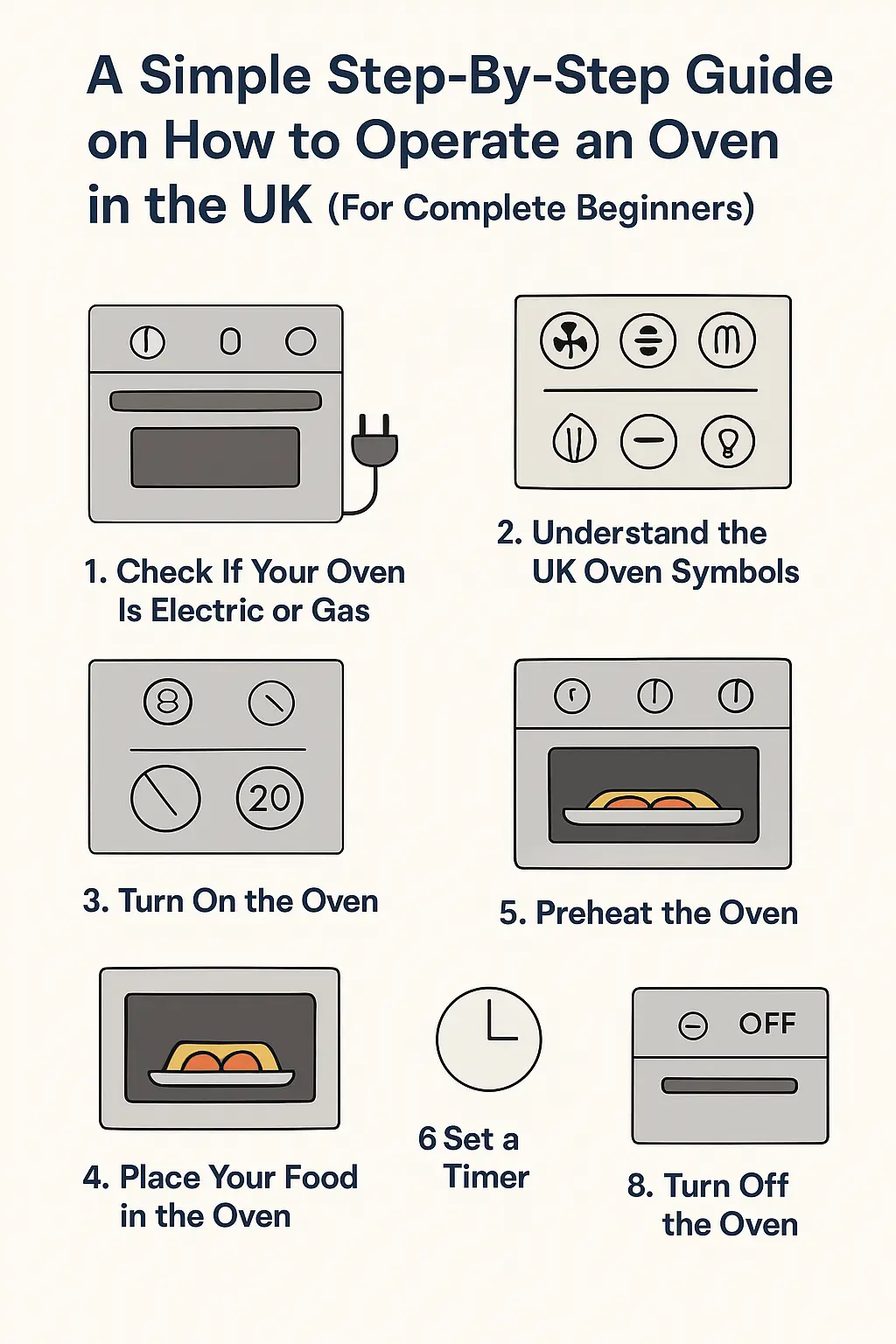
Step-By-Step Beginner Guide
How to Operate an Oven in the UK
These steps work for almost every UK oven model.
Step 1: Check If Your Oven Is Electric or Gas
Most UK kitchens have electric ovens. You can spot an electric oven because:
-
It has a plug or switch on the wall.
-
It heats up evenly.
-
It has a steady light.
-
You cannot see any flames.
Gas ovens have small visible flames inside.
If you are not sure, check near the oven door or inside the oven. Many labels say “Electric” or “Gas”.
When I lived in student housing, my oven was electric. It was easier to control because the heat stayed steady. In my next flat, I had a gas oven, and I learned that gas ovens heat faster at the bottom and can burn food if you place it too low.
Step 2: Understand the UK Oven Symbols
Here are the most common oven symbols you will see.
This is the part that confuses people the most.
Fan Oven Symbol
Looks like a circle with a fan inside.
This means the oven uses a fan to blow hot air around. This cooks food faster and evenly.
Conventional Oven Symbol
Two straight lines: one at the top, one at the bottom.
This means heat comes from above and below, with no fan.
Grill Symbol
A zig-zag line at the top.
This is for toasting, browning, or quick cooking.
Fan + Grill Symbol
Zig-zag line with a fan.
This cooks food quickly while grilling.
Light Symbol
A small bulb shape.
This turns on the oven light.
Defrost Symbol
A snowflake or wavy lines.
This helps defrost frozen food without cooking it.
Bottom Heat Symbol
A line only at the bottom.
Useful for pies or pastry.
Many beginners feel scared when they see these symbols.
But once you learn them, you will feel confident.
I stuck a small paper on my fridge with the symbols until I memorised them.
Step 3: Turn On the Oven
For Electric Ovens
Electric ovens usually have:
-
A main switch on the wall
-
A temperature knob
-
A function knob (with symbols)
Turn on the wall switch first.
Choose the symbol you want.
Then set the temperature.
For Gas Ovens
Gas ovens may need:
-
Turning the knob
-
Pressing a button to ignite
-
Holding the knob for 5–10 seconds
Be patient. Sometimes the flame takes a moment to appear.
Step 4: Set the Correct Temperature
Most UK recipes tell the temperature in Celsius (°C).
You will see numbers like:
-
100°C
-
160°C
-
180°C
-
200°C
-
220°C
For beginners, here is a simple idea:
-
160°C – slow cooking
-
180°C – normal cooking
-
200°C – fast or crispy cooking
-
220°C – very hot, for pizzas or roast potatoes
When I first moved to the UK, I kept wondering why my food was burning. Later, I found out that fan ovens cook 20°C faster. So if a recipe says 200°C, you can set your fan oven to 180°C.
This is something many beginners do not know.
Step 5: Preheat the Oven
Preheating means letting the oven heat up before putting food inside.
Most modern ovens take 8–12 minutes to preheat.
Why preheat?
Because food cooks unevenly if you put it into a cold oven.
To preheat:
-
Choose the symbol.
-
Set the temperature.
-
Wait for the preheat light to turn off, or wait 10 minutes.
Sometimes, when I am hungry and want to hurry, I skip preheating. But almost always, the food cooks better when I preheat.
Step 6: Place Your Food in the Oven
Use the oven rack or tray.
Simple rules:
-
Middle shelf for most foods
-
Top shelf for grilling
-
Bottom shelf for slow cooking
Never place plastic inside the oven.
Do not place paper unless it is baking paper.
If you are using foil trays, be careful. Gas ovens can react with foil and cause uneven heat.
Step 7: Set a Timer
Most UK ovens have a small timer button.
If yours does not, use your phone.
Timers help avoid burning food.
I burn less food now because I always set a timer.
Step 8: Let the Food Cook
Do not open the door too many times. This drops the heat.
Especially for cakes and baking, opening the door can make them fall flat.
Let the oven do its job.
Step 9: Turn Off the Oven
When done, turn off:
-
The function knob
-
The temperature knob
-
The wall switch
This is important for safety.
Step 10: Let the Oven Cool Down
Leave the oven door open slightly to release heat.
Do not touch hot trays without gloves.
Common Beginner Mistakes
Here are some mistakes I made and many beginners also make:
-
Setting the wrong symbol
-
Forgetting to preheat
-
Using Fahrenheit recipes in Celsius ovens
-
Putting food on the wrong rack
-
Not checking if a baking tin is oven-safe
-
Leaving the oven on after cooking
-
Opening the door too often
Avoid these and cooking will feel easy.
Safety Tips for Using a UK Oven
-
Always keep children away from the hot door.
-
Use oven gloves.
-
Do not store things inside the oven.
-
Keep the oven clean to avoid smoke.
-
Do not use metal in the microwave-oven combos.
-
If you smell gas, turn off everything and open windows.
Helpful Extra Sections You Requested
Below are the additional H2 and H3 sections (each 100+ words).
How to operate an oven step by step?
Operating an oven step by step is simple when you break it down. First, turn on the oven from the wall switch. Then choose the correct symbol based on what you want to cook. Next, set the temperature in Celsius. After that, preheat the oven for at least 10 minutes. Once it is hot, place your food inside using the right shelf. Close the door and set a timer so you do not overcook anything. Let the food cook without opening the door too many times. When the timer rings, turn off the oven and take your food out carefully. Over time, these steps will feel natural, and you will not even need to think about them.
What are the symbols on a UK oven?
UK ovens use simple symbols, but they confuse beginners because every oven looks slightly different. The fan symbol shows that the oven will spread hot air around for quicker and even cooking. The two-line symbol means a normal oven with heat coming from the top and bottom. The grill symbol is a zig-zag line and is used for toasting or browning food. Some ovens have a fan with a grill symbol for faster grilling. You may also see a light bulb symbol for turning the oven light on. Understanding these symbols helps you cook the right way and avoid accidents. With time, you will remember the symbols easily.
How do European ovens work?
European ovens, including UK ovens, work mostly on electric power and use Celsius for temperature control. They heat the inside space using heating elements placed at the top, bottom, or both. Many European ovens also have fan-assisted cooking, which helps food cook faster and more evenly. These ovens focus on even heat instead of strong flames like gas ovens in some countries. European ovens may look simple, but they have many features such as grilling, defrosting, baking, slow cooking, and preheating. Because heat spreads differently, European ovens often need 20°C lower temperature when using the fan setting. This is something many beginners learn only after burning a few meals.
Do ovens in the UK use Celsius?
Yes, almost all ovens in the UK use Celsius. This is the standard temperature measurement used in British cooking, recipe books, and supermarkets. You will see numbers like 160°C, 180°C, or 200°C printed on oven dials. If you come from a country that uses Fahrenheit, it may feel new at first. But Celsius is easy to learn. 180°C is a common temperature for most daily cooking. Fan ovens may cook faster, so you can reduce the temperature by about 20°C. When I first moved to the UK, I kept checking the internet to convert Fahrenheit to Celsius. After a few weeks of cooking, I got used to Celsius and now it feels natural.
Final Thoughts
Using a UK oven is not scary once you understand the symbols, the knobs, and the simple steps. Many beginners worry they will break something or burn food, but ovens are very beginner-friendly. With a little practice, you will feel confident. You will cook better meals and waste less time guessing.


You May Also Like
Designing the Perfect Barndominium Kitchen Layout
Concealed Kitchen Handles: Pros, Cons & Trends Explained